
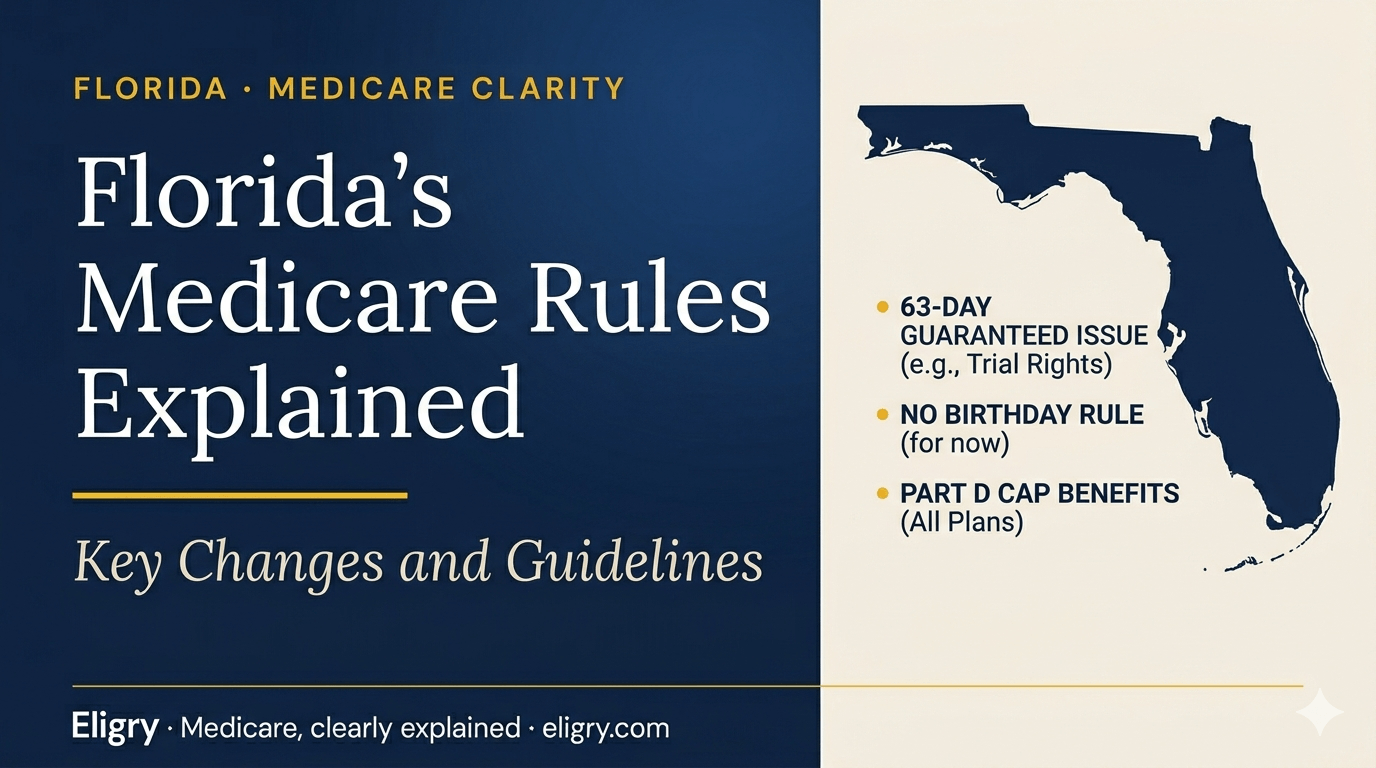
Florida Medicare Supplement birthday rule: what actually applies (and what doesn’t)
The Florida Medicare Supplement birthday rule is something people search for constantly — and the honest answer, which most insurance companies won’t tell you plainly, is that Florida doesn’t have one. Here’s what actually applies, and the exceptions that matter.
When people ask about the Florida Medicare Supplement birthday rule, they’re usually hoping for an annual switching window like California or Oregon offers — a guaranteed yearly opportunity to change Medigap plans without answering health questions. Florida doesn’t offer that. But the full picture has important exceptions you need to know about, because in a few specific situations, Florida law does force insurance companies to accept you with no health questions asked.
Knowing which situation you’re in can be the difference between locking in great coverage and being stuck with a plan that slowly raises your premium every year. Here’s how Medigap switching actually works in Florida as of 2026.
Does Florida have a Medicare Supplement birthday rule?
No. Florida does not have a Medicare Supplement birthday rule. Unlike California and Oregon, which let you switch Medigap plans annually around your birthday with no health questions, Florida requires medical underwriting for most plan changes. The only exceptions are specific Guaranteed Issue rights triggered by losing coverage, a Medicare Advantage trial period, or plan termination.
If you want to switch Medicare Supplement providers simply to get a lower premium, to move from one plan letter to another (say from Plan G to Plan N), or because you found a carrier you like better, you technically can apply at any time of year. There is no annual enrollment window specifically for Medigap.
But here’s the catch: in Florida, the new insurance company can medically underwrite you. That means they can:
- Ask detailed questions about your medical history, current medications, and any planned procedures
- Request records from your doctors
- Charge you a higher premium based on your health status
- Deny your application entirely if they decide you’re too expensive to insure
The Annual Election Period you hear about every fall — October 15 through December 7 — is for Medicare Advantage and Part D drug plans, not for switching Medigap plans without health questions. Many people confuse these because the advertising around AEP is so loud. Medigap plays by different rules, and the Florida Medicare Supplement birthday rule that some people assume exists is not among them.
Can you switch Medicare Supplement plans in Florida without underwriting?
Only in a few specific situations. Florida grants Guaranteed Issue rights when you lose employer or retiree coverage (63-day window), during the first 12 months after joining Medicare Advantage for the first time (trial right), or when your current plan is terminated or leaves your county. Outside these windows, insurers can deny you or charge more based on your health.
These Guaranteed Issue rights are the most valuable thing to know if you’re thinking about switching. I walk people through these windows every week in my practice — and the most common mistake I see is people not realizing they had a window until after it closed. The three most common ones are:
1. Losing employer or retiree health coverage
If you’re retiring and losing group health insurance, or if your former employer drops the retiree plan you’ve been on, you get a 63-day window to enroll in a Medigap plan with no health questions. This is a one-time opportunity — miss the window, and you’re back to underwriting. For most retirees, this is the single most important enrollment window of their Medicare lives. Plan for it.
2. Trial rights after first-time Medicare Advantage enrollment
If you joined a Medicare Advantage plan when you first became eligible for Medicare, Florida gives you a 12-month trial period. If you decide Advantage isn’t for you — maybe the network is too restrictive, or your favorite doctor dropped out — you have the legal right to switch back to Original Medicare plus a Medigap plan with no medical underwriting. After 12 months, the trial right expires and underwriting applies again. I talk to people every week who didn’t know this window existed until month 11 — don’t be one of them.
3. Plan termination or service-area changes
If your current Medicare Advantage plan stops operating in your Florida county, or the carrier discontinues the specific plan you’re on, you get Guaranteed Issue rights to enroll in certain Medigap plans. This happens more often than people realize — carriers pull plans from specific counties every year, especially in smaller markets outside the major metros.
Because the Florida Medicare Supplement birthday rule doesn’t exist and Florida has no continuous Medigap open enrollment, the Guaranteed Issue windows are often the only opportunities you’ll get to switch plans without being medically underwritten. If you let one of these windows close without acting, you may be stuck with your current plan — at whatever price the carrier decides to charge — for the rest of your life.
What is the Florida Medigap Free Look period?
Florida mandates a 30-day Free Look period for all new Medigap policies. After you’re accepted, you have 30 days to review the plan, use it, and cancel for a full premium refund if you’re not satisfied. Do not cancel your old policy until the new one is officially active — canceling early can create a dangerous coverage gap.
One critical warning from my own experience helping clients: do not cancel your old policy until the new one is officially active and you have your new ID card in hand. People who cancel early end up with a coverage gap, and in the worst cases, they end up uninsured for several weeks while paperwork processes. I’ve seen this happen to people who assumed the switch would be instant. Always overlap for a few days.
How do Florida Medigap switching rules compare at a glance?
| Feature | Florida rule (2026) |
|---|---|
| Birthday rule? | No. Florida has no automatic annual switching window. |
| When can you apply to switch? | Any time of year — but most applications require underwriting. |
| Medical underwriting required? | Yes, unless you have a Guaranteed Issue right. |
| Trial right for Medicare Advantage? | Yes. 12-month window to return to Medigap with no underwriting. |
| Free Look period? | 30 days after enrollment to cancel and get your premium back. |
| Annual Election Period switches? | Only for Medicare Advantage and Part D, not Medigap. |
What is the best strategy for choosing a Florida Medicare Supplement plan?
Because Florida has no birthday rule and switching later requires medical underwriting, your initial plan choice matters more than in most states. Most Floridians in a Guaranteed Issue window choose Plan G for its comprehensive coverage and Excess Charge protection. Equally important: choose a carrier with stable rate history, not the lowest introductory premium.
If you’re retiring soon, turning 65, or about to lose employer coverage, the enrollment window that opens is likely the last time in your life you’ll be guaranteed acceptance into any Medigap plan you want without health questions. Because the Florida Medicare Supplement birthday rule doesn’t exist, the enrollment windows you do get become disproportionately important. A few things are worth thinking about carefully.
Why most Floridians choose Plan G
Because switching later is so difficult in Florida, most people in this situation choose Plan G. It has the most comprehensive coverage currently available to new enrollees, and importantly, it protects you from something called “Excess Charges” — fees that some doctors charge above the Medicare-approved rate. I see these charges regularly in my Florida practice, especially from specialists in the larger retirement markets like Sarasota, Naples, and the Tampa Bay area. Plan G is the only currently-available plan that covers them in full.
Why rate stability is worth paying for
Some newer carriers offer low “teaser” rates to attract 65- and 70-year-olds, then raise them significantly after two or three years — by which point you’re older, possibly have new health conditions, and can’t pass underwriting to switch. Look for carriers with a long history of stable rate increases in Florida. The cheapest premium today can easily become the most expensive premium in five years. I’ve seen this pattern play out dozens of times with clients who come to me after their rates doubled.
Why you should get help before you commit
Medigap decisions are hard to reverse in Florida. Before you apply, talk to an independent advisor who represents multiple carriers and can compare not just today’s premium but each carrier’s rate history, customer service reputation, and financial stability. The call is free, carriers pay advisors when someone enrolls, and the premium is exactly the same whether you enroll through an advisor or directly with the insurance company — so there’s no cost to getting a second opinion.
Thinking about a Medigap switch in Florida?
Let’s talk through your situation before you apply. I’ll compare your options across carriers, explain the timing, and help you decide whether you should switch, stay, or wait.
Book a free Medicare plan review Or call (352) 464-4400 — available 7 days a week by appointment