
Retirement Planning · Medicare Education · Updated May 2026 · 12 min read
This article is part of the Retirement Mistakes That Can Cost You Thousands series.
When most people first enroll in Medicare, they assume they will always be able to change plans later if they are unhappy.
Unfortunately, that is not always true. And for some retirees, discovering this too late becomes one of the biggest healthcare and financial mistakes of their retirement.
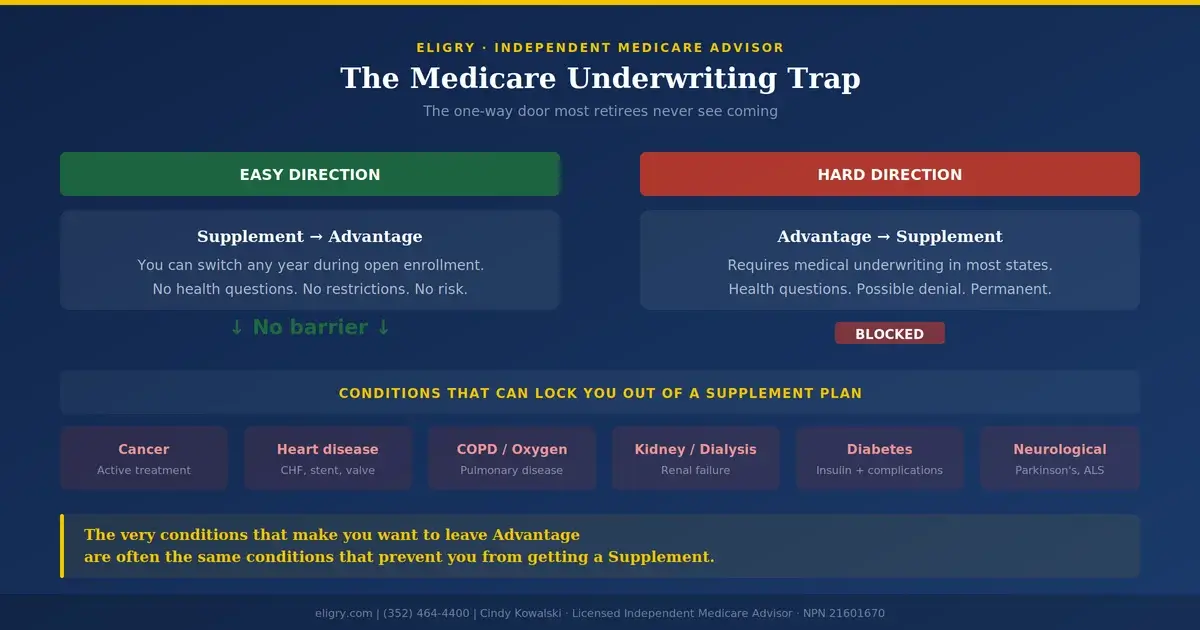
I call it the Medicare underwriting trap.
It happens when someone enrolls in a Medicare Advantage plan — often because of a $0 premium and TV commercials that make it seem like the obvious choice — thinking they can simply switch to a Medicare Supplement plan later if they want to. Years down the road, when their health changes and they try to make that switch, they discover that their health now prevents them from qualifying.
Most people are never fully warned about this before they enroll.
This is not about whether Medicare Advantage is “good” or “bad.” It is about understanding that some Medicare decisions are easy to make but nearly impossible to reverse — and that the window where you have the most options is shorter than most people realize.
What is the Medigap Open Enrollment Period?
When you first become eligible for Medicare Part B and are 65 or older, federal law gives you a one-time, 6-month Medigap Open Enrollment Period. During this window, every insurance company selling Medigap in your state must accept your application, cannot charge you more because of health conditions, and cannot apply medical underwriting. This is the easiest — and in most states, the only guaranteed — time you will ever have to enroll in a Medicare Supplement plan.
After that window closes, the rules change significantly.
In most states, if you decide later that you want to move from a Medicare Advantage plan to a Medicare Supplement plan, you have to go through medical underwriting. The insurance company reviews your health history and decides whether to accept you, charge you a higher premium, or deny your application entirely.
That means your current health matters. Your medications matter. Your diagnoses matter. Surgeries and treatments you have had in the past two to five years matter — depending on the carrier’s look-back window.
And depending on your health at that point, you could be declined.
Why does the Medicare underwriting trap catch so many people?
Because the decision to enroll in Medicare Advantage feels easy and risk-free at the time. The premiums are low or $0. Extra benefits like dental, vision, and gym memberships sound appealing. The TV commercials make it look simple. And in many cases, nobody fully explains the long-term trade-offs — especially the underwriting reality of trying to switch later.
The trap is not Medicare Advantage itself. Medicare Advantage plans can absolutely be the right fit for some people. The trap is making that choice without understanding what you are giving up — specifically, the guaranteed ability to buy a Supplement plan regardless of your health.
Many people only reconsider their coverage after something changes. They develop a serious health condition. They face expensive treatments with high out-of-pocket costs. They start traveling more and discover their plan only covers emergencies outside the service area. They get frustrated with prior authorization delays or discover their doctor left the network.
Unfortunately, those are often the exact moments when underwriting becomes hardest to pass.
What health conditions can cause a Medigap application to be denied?
The most common conditions that result in automatic declines across most carriers include active cancer treatment, ESRD or dialysis, insulin-dependent diabetes with complications, COPD requiring oxygen, organ transplants, congestive heart failure, and certain neurological conditions like ALS or Parkinson’s. However, every carrier has different guidelines, different look-back windows, and different thresholds — which is why working with an independent advisor who knows multiple carriers’ underwriting rules matters.
Here is a general overview of how carriers typically evaluate common conditions:
| Condition | Examples | Typical result |
|---|---|---|
| Cancer | Active treatment, recent diagnosis | Usually declined during treatment; waiting period after remission (often 2-5 years depending on carrier) |
| Cardiovascular | Congestive heart failure, recent stent, valve replacement | Often declined or rated up significantly |
| Pulmonary | COPD requiring oxygen, emphysema | Frequently declined if oxygen is in use |
| Endocrine | Insulin-dependent diabetes with complications | Varies widely — some carriers decline, others accept with conditions |
| Renal | Kidney disease, dialysis, transplant | Usually declined |
| Neurological | Parkinson’s, ALS, MS, recent stroke | Often declined |
| Autoimmune | Lupus, rheumatoid arthritis on biologics | Varies — some carriers accept, others decline |
| Recent hospitalization | 2+ hospitalizations in past 2 years | Common decline trigger across most carriers |
| Pending surgery | Any recommended procedure not yet completed | Must be completed before applying |
The critical point: the very conditions that make someone want to leave their Medicare Advantage plan are often the same conditions that prevent them from getting a Supplement. That is the trap. By the time the need becomes urgent, the door may have closed.
If you want to check your own eligibility before applying, I built a free tool for that: Medigap underwriting pre-screen tool →
What does the Medicare underwriting trap look like in real life?
I hear some version of this story regularly:
“Nobody ever explained I might not be able to get a Supplement later.”
A 68-year-old client came to me after three years on a Medicare Advantage plan. She had been diagnosed with breast cancer the year before. Treatment was going well, but the prior authorization delays and out-of-pocket costs were overwhelming. She wanted to switch to a Medigap Plan G for the predictability and nationwide access.
When we looked at underwriting guidelines across every carrier offering a Supplement plan in her ZIP code, the answer was the same: declined. Active cancer treatment within the past two years is an automatic disqualifier with virtually every Supplement carrier.
She was not stuck because of a bad plan. She was stuck because nobody explained the one-way door before she walked through it at 65.
This is why I have this conversation with every client before they enroll in anything. Not to scare them away from Advantage plans — but to make sure they understand the trade-off they are making while they still have a choice.
Are there exceptions to the Medicare underwriting trap?
Yes. Several federal and state-level protections can give you guaranteed issue rights to buy a Medigap plan without underwriting, even after your initial 6-month window has closed. But these exceptions are specific, time-sensitive, and vary by state — which is why knowing about them before you need them matters.
The 12-month trial right
If you joined a Medicare Advantage plan when you were first eligible for Medicare, you generally have a one-time, 12-month trial right. During this window, you can drop the Advantage plan, return to Original Medicare, and enroll in any Medigap plan with guaranteed acceptance. No health questions. No underwriting. No denial.
The clock starts the day your Advantage coverage begins. Once it expires, this right does not come back in most states. Many people never hear about it until after the deadline has already passed.
Full guide: how the 12-month trial right works →
Other guaranteed issue situations
You may also have guaranteed issue rights if your Medicare Advantage plan leaves your area or loses its Medicare contract, you move out of your plan’s service area, your plan commits fraud or misleads you about coverage, or your employer or union coverage ends. These situations are less common, but they are worth knowing about — especially if someone has told you that you have no options.
State-specific protections
Some states go beyond federal minimums. New York and Connecticut offer year-round guaranteed issue for anyone 65 and older — you can apply for any Medigap plan at any time without underwriting. Indiana implemented a birthday rule starting January 2026 that gives Medigap policyholders a 60-day window around their birthday to switch carriers on the same plan letter without underwriting (though this applies to Supplement-to-Supplement switches, not Advantage-to-Supplement). Illinois has a similar birthday rule.
Rules vary significantly by state. If you are in one of the 22 states where Eligry is licensed, I can tell you exactly what applies to your situation.
For state-specific underwriting rules, see:
What questions should you ask before choosing a Medicare plan?
Before enrolling in any Medicare plan — Advantage or Supplement — these are the questions that matter most:
- What happens if my health changes in 3-5 years? Will I still have the option to change coverage, or will underwriting lock me out?
- Could I qualify for a Medigap plan later? Based on my current health and my state’s rules, what would happen if I applied after this window closes?
- Do I travel or split time between states? Medicare Advantage networks are local. Original Medicare works everywhere.
- What are my worst-case out-of-pocket costs? Not the premium — the total in a year when something serious happens. Plan G caps you at $283. Advantage can run up to $9,250.
- Do I understand the prior authorization rules? Under Advantage, the carrier reviews and approves many services before your doctor can provide them. Under Original Medicare with a Supplement, your doctor decides.
- Was I shown all three paths? If you only heard about Advantage, you did not get the full picture. See all three options explained →
These are the kinds of questions that most advertisements, mailers, and TV commercials never discuss. They are also the questions that can save you tens of thousands of dollars and years of frustration.
The bottom line on the Medicare underwriting trap
The Medicare underwriting trap is not about fear. It is about understanding the long-term consequences of a decision before you make it.
For some people, Medicare Advantage is the right fit. I enroll clients in Advantage plans regularly when it genuinely matches their situation. For others, the long-term flexibility and predictability of Original Medicare paired with a Supplement plan is more important — especially if they value nationwide provider access, no pre-authorization, and the peace of mind that comes from capped costs.
The key is making an informed decision while your options are still open. Because once your health changes, some Medicare decisions become much harder — or impossible — to reverse.
One of the reasons I became a licensed Medicare advisor was because I nearly fell into this trap myself. Nobody explained my options at 65. Nobody mentioned the one-way door. I started Eligry so that other people would not have to discover these things the hard way.
Frequently Asked Questions
Can I switch from Medicare Advantage to a Medicare Supplement?
You can leave Medicare Advantage during the Annual Enrollment Period (October 15 – December 7) or during certain Special Enrollment Periods. However, getting a Medigap plan afterward requires medical underwriting in most states. If your health has changed, you may be denied or charged a higher premium. Full switching guide →
What is the 12-month Medicare Advantage trial right?
If you enrolled in Medicare Advantage when you were first eligible for Medicare, you have a one-time, 12-month window to drop the plan and buy any Medigap plan with guaranteed acceptance — no health questions and no underwriting. The clock starts the day your Advantage coverage begins.
Does Indiana have a Medicare Supplement birthday rule?
Yes. Starting January 1, 2026, Indiana gives Medigap policyholders a 60-day window around their birthday each year to switch to the same plan letter with a different carrier without medical underwriting. This rule applies to Supplement-to-Supplement switches, not Advantage-to-Supplement. Indiana birthday rule details →
What conditions cause Medigap applications to be denied?
Common conditions that result in automatic declines include active cancer treatment, congestive heart failure, COPD requiring oxygen, kidney disease or dialysis, neurological conditions like Parkinson’s and ALS, and two or more hospitalizations in the past two years. Every carrier has different guidelines and look-back windows.
Does it cost anything to work with an independent Medicare advisor?
No. Insurance carriers compensate independent advisors when you enroll. Your premium is exactly the same whether you use an advisor or enroll on your own. There is never a fee to you.
Talk to Cindy — It’s Free
If you are not sure whether you are at risk for the underwriting trap — or if you want to understand all of your options before your window closes — I am here to help. No pressure. No obligation. Just clear answers.
Schedule My Free Consultation ☎ (352) 464-4400Available 7 days a week · I’ll tell you honestly if the best plan for you isn’t one I sell.
Related Reading
Cindy Kowalski is the founder of Eligry LLC, a licensed independent Medicare and retirement advisory firm serving clients in 22 states. She holds AHIP 2026 certification and has more than 40 years of business experience, including 23 years in enterprise sales at AT&T and 16 years running an IT consulting firm. She transitioned to Medicare advising after a personal near-miss enrollment experience. She is not employed by or exclusively contracted with any insurance carrier. NPN 21601670.
We do not offer every plan available in your area. Please contact Medicare.gov, 1-800-MEDICARE, or your local State Health Insurance Program (SHIP) to get information on all of your options. Not affiliated with or endorsed by the U.S. government or the federal Medicare program. © 2026 Eligry LLC.