
Ask someone how much they expect to spend on healthcare in retirement, and you’ll usually hear something like “I’ll have Medicare, so I should be fine.” That answer misses the mark by hundreds of thousands of dollars.
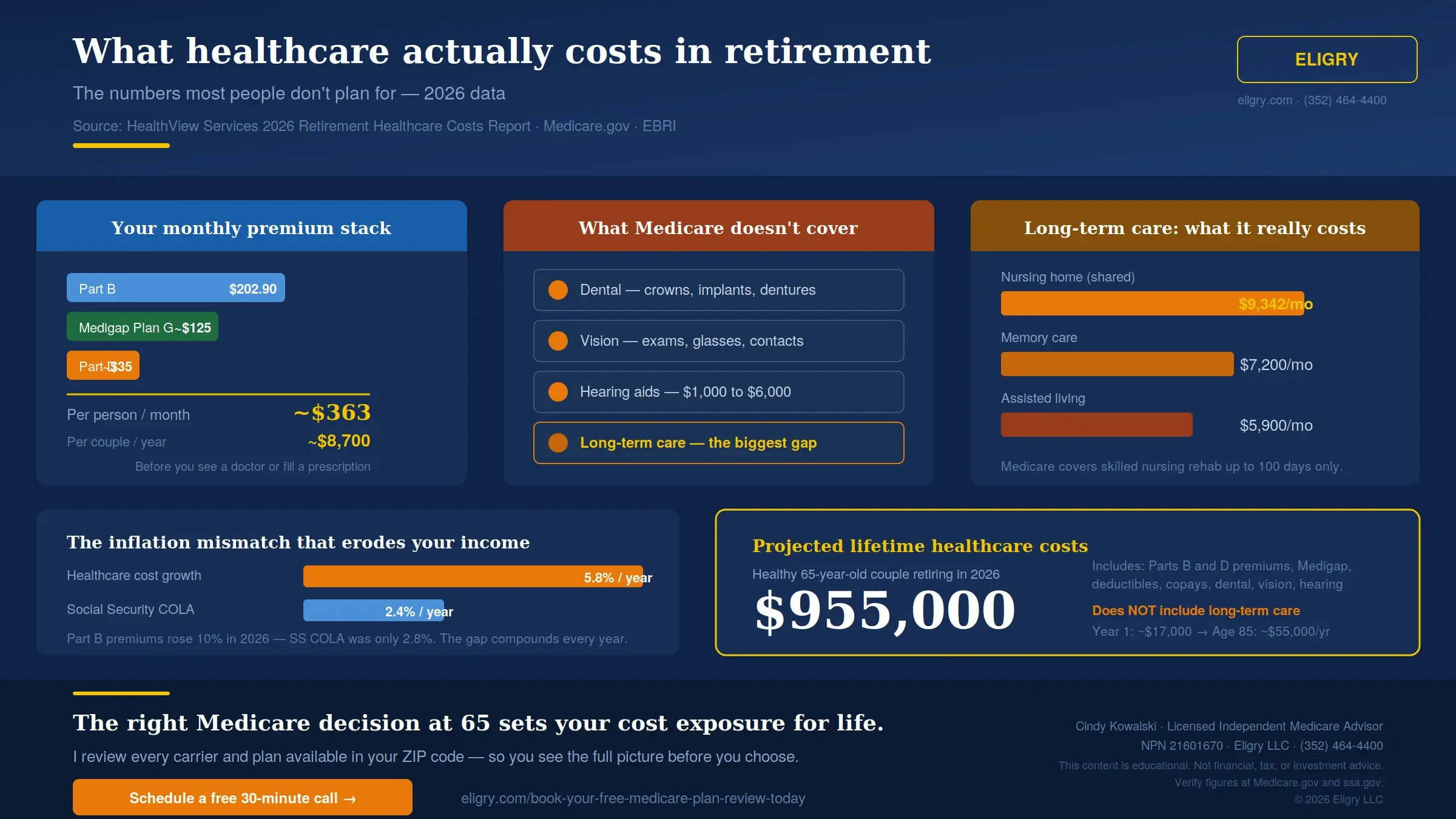
Medicare is essential. It’s also incomplete. It doesn’t cover everything, it isn’t free, and the costs associated with it are rising faster than Social Security can keep up. For a healthy 65-year-old couple retiring in 2026, projected lifetime healthcare expenses — including Medicare premiums, supplemental insurance, deductibles, copays, dental, vision, and hearing — approach $955,000 according to the HealthView Services 2026 Retirement Healthcare Costs Report.
That number isn’t designed to scare you. It’s designed to make you plan. And planning starts with understanding what you’re actually going to pay.
What Medicare Costs in 2026 — the Baseline
Most people know Medicare isn’t entirely free. But few realize how many separate cost components are involved, or how quickly they add up — even before you get sick.
| Cost Component | 2026 Amount | Notes |
|---|---|---|
| Part A premium | $0 for most people | Free if you or a spouse paid Medicare taxes for 10+ years |
| Part A deductible | $1,736 per benefit period | Applies each time you’re admitted to a hospital |
| Part B premium | $202.90/month | Standard amount; higher earners pay more (IRMAA) |
| Part B deductible | $283/year | After this, you pay 20% coinsurance with no cap |
| Part D premium (avg) | ~$34.50/month | Standalone drug plan average; varies by plan |
| Part D out-of-pocket cap | $2,100/year | New cap introduced in 2025; adjusted upward for 2026 |
| Medigap Plan G premium (avg) | ~$125/month | National average; varies significantly by state, age, carrier |
For someone on Original Medicare with a Medigap Plan G supplement and a standalone Part D drug plan, the monthly premium stack looks like this: $202.90 (Part B) + $125 (Medigap) + $27–35 (Part D) = roughly $355 to $363 per month. That’s $4,260 to $4,356 per year — per person — before you’ve seen a doctor, filled a prescription, or sat in a dentist’s chair.
For a couple, double it. That’s over $8,500 per year in premiums alone, and that’s the baseline for healthy people with standard income.
What Medicare Does Not Cover
This is where the planning gap gets serious. Original Medicare was designed in 1965 and its coverage structure still reflects that era. Several major categories of healthcare that retirees routinely need are simply not included.
Dental care
Original Medicare does not cover routine dental exams, cleanings, fillings, crowns, implants, or dentures. Some Medicare Advantage plans include basic dental benefits, but coverage limits are typically $1,000 to $2,000 per year — often not enough for a single crown or extraction, let alone implants. Standalone dental insurance for seniors typically runs $30 to $75 per month with annual maximums of $1,000 to $1,500.
Vision care
Original Medicare does not cover routine eye exams, eyeglasses, or contact lenses. It covers eye exams for specific conditions like glaucoma or macular degeneration, and it covers cataract surgery. But the annual eye exam and prescription lenses most retirees need are entirely out of pocket unless you have a Medicare Advantage plan with vision benefits or a standalone vision plan.
Hearing aids
Original Medicare does not cover hearing aids or the routine hearing exams needed to get them fitted. A pair of hearing aids ranges from $1,000 to $6,000 depending on technology level. Some Medicare Advantage plans have started including hearing aid allowances, but limits vary widely.
Long-term care
This is the single largest gap in Medicare coverage and the one that devastates retirement savings most often. Medicare does not cover long-term custodial care — the kind of help people need with bathing, dressing, eating, and moving around when they can no longer manage independently.
Medicare covers skilled nursing facility care for up to 100 days following a qualifying three-day hospital stay, and only for rehabilitation — not ongoing custodial needs. After day 20, there’s a $217 per day copay in 2026. After day 100, you pay everything.
The Inflation Problem: Healthcare Costs vs. Social Security
Here’s the number that should shape how you think about retirement healthcare: healthcare cost inflation has been running at approximately 5.8% per year, while Social Security cost-of-living adjustments have averaged roughly 2.4%.
In 2026, this played out exactly as projected. The Part B premium jumped 10% (from $185 to $202.90) while the Social Security COLA was only 2.8%. The premium increase consumed roughly one-third of the average retiree’s COLA increase — leaving only two-thirds to cover every other rising cost in their life.
The HealthView Services report puts the long-term impact in sharp terms: a healthy 55-year-old couple with average Social Security benefits and national average healthcare costs will need 104% of their Social Security benefits to cover healthcare premiums and out-of-pocket expenses by the time they retire. More than their entire Social Security check — just for healthcare.
This is why the conversation about when to claim Social Security matters so much. A larger benefit from delaying to age 70 doesn’t just mean more income — it means a bigger base for future COLAs, which is the only built-in hedge most retirees have against healthcare inflation.
The IRMAA Factor: When Higher Income Means Higher Premiums
If your income exceeds certain thresholds, you don’t just pay the standard Part B and Part D premiums — you pay IRMAA surcharges that can add thousands of dollars per year.
| Filing Status | 2024 MAGI Threshold | 2026 Part B Monthly Premium |
|---|---|---|
| Single or MFJ | ≤ $109,000 / $218,000 | $202.90 (standard) |
| Single or MFJ | $109,001–$137,000 / $218,001–$274,000 | $293.30 |
| Single or MFJ | $137,001–$171,000 / $274,001–$342,000 | $419.30 |
| Single or MFJ | $171,001–$214,000 / $342,001–$428,000 | $545.20 |
| Single or MFJ | > $214,000 / > $428,000 | $689.90 |
The critical detail: IRMAA uses your income from two years prior. So your 2024 income determines your 2026 premiums. A Roth conversion, a home sale, or even a one-time capital gain in the wrong year can push you into a higher bracket for twelve months of elevated premiums.
This is the intersection where Social Security timing, tax planning, and Medicare cost management all converge. Getting it right requires thinking about all three at once, not one at a time.
The Real Lifetime Cost: Putting It All Together
Here’s what the 2026 projections look like for a healthy 65-year-old couple on Original Medicare with Medigap Plan G, Part D coverage, and dental premiums included:
| Cost Category | Projected Lifetime Total |
|---|---|
| Medicare Parts B & D premiums | ~$689,000 |
| Medigap (Plan G) premiums | Included above |
| Deductibles, copays, coinsurance | ~$100,000–$130,000 |
| Dental, vision, hearing | ~$130,000–$140,000 |
| Total projected lifetime healthcare costs | ~$955,000 |
That total does not include long-term care. If either spouse needs assisted living ($5,900/month average) or nursing home care ($9,342/month average), the number climbs by tens or hundreds of thousands more.
These are national averages. Your actual costs will depend on your state, your health, the medications you take, and the coverage path you choose. In the first year of retirement, a couple on this coverage path can expect to spend approximately $17,000. By age 85, annual costs are projected to exceed $55,000.
Five Ways to Prepare — Starting Now
1. Choose the right Medicare coverage path upfront. The decision between Medicare Supplement and Medicare Advantage isn’t just about monthly premium — it’s about lifetime cost exposure. A Medigap plan costs more each month but eliminates the 20% Part B coinsurance risk that has no annual cap. An Advantage plan costs less monthly but exposes you to copays and out-of-pocket maximums that can reach $9,350 per year (in-network). The right choice depends on your health, your doctors, and your risk tolerance. And because of medical underwriting, this decision is hardest to reverse later.
2. Fund a Health Savings Account (HSA) before you enroll in Medicare. If you have an HSA-eligible high-deductible health plan before age 65, you can contribute up to $4,400 (individual) or $8,750 (family) in 2026, plus a $1,000 catch-up contribution if you’re 55 or older. HSAs have a triple tax advantage — pre-tax contributions, tax-free growth, and tax-free withdrawals for qualified medical expenses. Once you enroll in Medicare, you can no longer contribute, but you can still withdraw tax-free for medical expenses indefinitely.
3. Plan Roth conversions strategically. The years between retirement and age 70 — before Social Security and RMDs kick in — are often your lowest-income years. Converting traditional IRA money to Roth during this window means paying tax at a lower rate now and permanently removing that money from the IRMAA calculation in future years. A couple who converts $500,000 to Roth before claiming Social Security could reduce their annual IRMAA exposure by $20,000 to $30,000 in income they’d otherwise have to draw from traditional accounts.
4. Budget for dental, vision, and hearing separately. These are real, recurring costs that surprise people every year. Budgeting $3,000 to $5,000 per person annually for dental and vision — or purchasing standalone coverage — ensures these expenses don’t force difficult tradeoffs with other parts of your plan.
5. Have the long-term care conversation now, not later. Whether you purchase long-term care insurance, self-insure through dedicated savings, or explore hybrid life/LTC products, the decision is always cheaper and easier to make when you’re younger and healthier. At the national average nursing home cost, savings of $250,000 last roughly 26 months. That’s not a plan — that’s a countdown. Long-term care planning deserves a dedicated conversation.
Where This Fits in Your Retirement Plan
Healthcare costs aren’t a separate line item you deal with after you’ve figured out everything else. They interact with your Social Security claiming age, your tax strategy, your life insurance structure, and your annuity decisions. A Roth conversion that reduces IRMAA also reduces the taxes on your Social Security benefits. Delaying Social Security increases your COLA base, which is your primary hedge against healthcare inflation. Choosing the right Medicare plan at 65 determines your cost exposure for every year that follows.
I’m not a financial planner or tax advisor. But Medicare coverage is my specialty, and I see every day how these pieces connect. People come to me surprised by their Part B premium. Surprised that their dental crown wasn’t covered. Surprised that their spouse’s nursing home stay wiped out savings they thought would last a decade. The common thread is that nobody walked them through the full picture before they made their decisions.
That’s what this page — and this entire Retirement Planning Hub — is here to change.
Want to Understand What Your Medicare Coverage Will Actually Cost?
I’ll walk you through your specific options — every carrier and plan available to you — so you understand exactly what you’ll pay each month and what you’ll be responsible for when you need care.
Schedule a Free CallRelated Reading
← Back to the Retirement Planning Hub
Other retirement topics:
When to Claim Social Security — The math behind 62 vs 67 vs 70, and how it affects your Medicare premiums.
The Medicare Supplement Underwriting Trap — Why your health at 65 determines your options for life.
Indexed Universal Life (IUL) Explained — What it is, who it’s actually for, and the red flags to watch for.
Annuities Explained — The five types, real costs, and when they make sense.
Retirement Tax Mistakes — IRMAA triggers, Roth conversions, and income planning. (Coming soon)
Long-Term Care Planning — The risk most retirees ignore until it’s too late. (Coming soon)
Eligry LLC · Cindy Kowalski · Licensed Independent Medicare Advisor · NPN 21601670
(352) 464-4400 · cindy@eligry.com
This content is educational and does not constitute financial, tax, or investment advice. Medicare premiums, deductibles, IRMAA thresholds, and long-term care costs are subject to change annually. Verify current figures at Medicare.gov and ssa.gov. Consult a qualified financial planner, tax professional, or elder law attorney before making retirement healthcare funding decisions. Eligry LLC provides Medicare guidance — not financial planning, tax preparation, or investment advisory services.
We do not offer every plan available in your area. Currently we represent eight carriers which offer 16 products in your area. Please contact Medicare.gov, 1-800-MEDICARE, or your local State Health Insurance Program (SHIP) to get information on all of your options. Not affiliated with or endorsed by the U.S. government or the federal Medicare program.
© 2026 Eligry LLC. All Rights Reserved.